
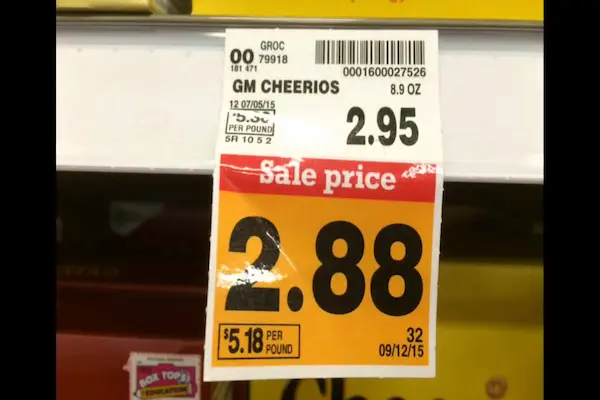
Confusing store price tags can make a simple shopping trip feel like a mini math test, especially when “per unit” signs and sale wording compete for your attention.
Clear, practical patterns exist on most tags, and once you learn them you can compare prices fast, avoid traps, and feel confident at the shelf.
How to Read Price Tags: The Big Picture Before You Compare Anything
Start by treating every shelf label like a tiny summary of a deal, because it usually combines the product identity, the price type, and the conditions in one crowded space.
Instead of hunting for the biggest number first, scan for context clues like unit size, price basis, and promo rules, since those details decide what the number really means.
Think of the tag as having a “headline” and “fine print,” where the headline grabs attention and the fine print protects the store from misunderstandings.
Notice how your brain naturally locks onto bold fonts and bright colors, because that design is meant to create urgency even when the value is only average.
Use a simple habit of reading left to right or top to bottom every time, so your eyes don’t skip the one line that changes the entire cost.
Remember that the best comparison happens when two items share the same unit basis, which is why per unit and per kilo price lines matter so much.
- Accuracy improves when you identify the product and size first, since the wrong variant can make a “deal” look better than it is.
- Confidence grows when you locate the unit price next, because it lets you compare different packages without mental gymnastics.
- Speed comes from checking promo conditions last, because rules like limits and membership pricing only matter after the base value looks good.
The Anatomy of Store Price Tags: What Each Part Usually Means
Most store price tags include an item name or brief description, and that short text is your first defense against grabbing the wrong flavor, size, or model.
A product code such as a SKU or barcode number often appears nearby, and while you rarely need it, it helps staff confirm the exact item at checkout.
The main price is typically displayed in the largest font, yet that number can represent different things depending on whether it is regular, promotional, or membership-based.
A secondary line often shows the unit price, and that line may be labeled per unit, per 100 g, per kilo price, per ounce, or per liter depending on local norms.
Promotional phrases and discount labels tend to sit around the edges, where they can be noticed quickly without taking responsibility for clarity.
Conditions such as “limit X,” “with card,” or “when you buy Y” are frequently smaller, because they reduce the appeal if you notice them too early.
- Product identification usually includes brand, variety, and size, so matching it to the package prevents accidental comparisons across different weights.
- Main price usually reflects the cost you pay per package, so it is useful for budgeting but weak for comparing different sizes.
- Unit price is designed for comparison, so it is the best anchor when deciding between brands or package formats.
- Promotion text defines eligibility, so it should be read like rules rather than marketing.
Common abbreviations you may see on shelf labels
- “ea” often means each, so the price refers to a single item rather than a weight-based portion.
- “kg” and “g” refer to kilograms and grams, so a per kilo price can be derived even when the tag shows per 100 g.
- “L” and “mL” refer to liters and milliliters, so unit price comparisons work best when both items use the same volume basis.
- “BOGO” often means buy one get one, yet the exact discount still depends on whether the second item is free or partially reduced.
- “w/” often means with, so “w/ card” or “w/ app” signals a condition you must meet to get the displayed price.
Shelf Tag vs Package Label: Why Two “Prices” Can Both Be True
A shelf label is the store’s promise of what the register should charge, while the package print is usually the manufacturer’s information about contents and suggested serving details.
Occasionally the package shows a suggested retail price or older pricing info, yet the shelf tag and checkout system usually control what you actually pay.
Weights on the package matter most for variable-weight items like produce, deli, or meat, because the final price depends on the exact weight you receive.
Fixed-price packages like cereal or soap usually match the shelf size exactly, yet a redesigned package can create subtle size changes that only the unit price reveals.
Look for “net weight” or “net contents” on the package, because that number is the base for unit price math even when the front label is flashy.
Keep in mind that packaging can change without obvious visual differences, so trusting the unit price line helps you spot shrinkflation-style size reductions without guesswork.
Situations where shelf labels deserve a second look
- Misplaced items can sit under the wrong shelf tag, so matching the product name and size avoids an unpleasant checkout surprise.
- Similar varieties may share a display area, so verifying flavor, scent, or model number prevents accidental premium upgrades.
- Endcap promotions may have separate tags, so checking that the specific sign applies to the exact item keeps your expectations realistic.
- Clearance sections sometimes mix products, so reading each tag carefully prevents assuming the whole shelf shares the same discount.
Regular Price vs Sale Price: How to Read Price Tags Without Being Rushed
Regular price is the baseline cost when no promotion applies, and it is your reference point for deciding whether a deal is truly special.
Sale price is a temporary reduction tied to a time window or stock plan, so it can be real value or simply a small nudge framed as excitement.
Some tags show “Was” and “Now,” yet the usefulness of that comparison depends on whether the “Was” price reflects a meaningful recent period.
Watch for wording like “Save” paired with a dollar amount, because it can be accurate while still hiding the fact that another brand is cheaper even without a sale.
Consider how your budget feels when the sale price encourages extras, since buying more than you need can erase any savings through waste or clutter.
Use the unit price line as your steady compass, because it stays comparable even when a sale distorts the emotional impact of the big bold number.
- Regular price helps you know what “normal” looks like, so you can recognize meaningful discounts when they appear.
- Sale price helps you decide timing, so you can stock up responsibly on non-perishables you truly use.
- Unit price helps you decide value, so you can choose the best deal even when both items claim a sale.
Per Unit and Per Kilo Price: The Fastest Way to Compare Different Sizes
Unit pricing exists to solve the exact confusion most shoppers feel, because it converts different package sizes into a common language like cost per gram, per kilo price, or per liter.
Once you trust the unit price line, comparing a small premium brand to a large budget brand becomes a simple check rather than a mental math marathon.
Per kilo price is especially helpful for foods sold by weight, because it lets you compare cuts, brands, and package sizes on equal terms.
Some stores display per 100 g instead of per kilo price, and multiplying by ten gives you the per kilo equivalent when you want a familiar anchor.
Volume-based unit prices work similarly, because cost per liter makes it easier to compare concentrate versus ready-to-drink formats when sizes vary wildly.
Even in non-food aisles, unit price can show cost per sheet, per wash, or per count, which helps you avoid paying more for fancy packaging and fewer uses.
Quick examples that make unit pricing click
- Example thinking: a 500 g bag at $4.00 equals $8.00 per kilo price, while a 1 kg bag at $7.50 equals $7.50 per kilo price.
- Example thinking: a 750 mL bottle at $6.00 equals $8.00 per liter, while a 1 L bottle at $7.50 equals $7.50 per liter.
- Example thinking: a 12-count pack at $6.00 equals $0.50 each, while a 20-count pack at $9.00 equals $0.45 each.
Why unit price sometimes looks “wrong” at first glance
- Different bases can confuse you, so comparing per 100 g to per kilo price requires converting to the same scale.
- Different item versions can distort results, so a “family size” and a “premium recipe” might not be directly comparable even with unit pricing.
- Different promotions can change the math, so multi-buy discounts may not be reflected in unit price until you apply the deal conditions.
- Different measurement types can mislead, so comparing per ounce to per liter is not useful unless you convert properly.
How to Read Price Tags When Units Change Between Brands and Categories
In many aisles you will see one item priced per count and another priced per weight, and that mismatch makes it easy to compare the wrong numbers with confidence.
Converting to one shared basis is the simplest solution, and the unit price line often already did that work if the store measured both items consistently.
For paper goods, the meaningful unit might be per sheet or per square meter, because roll length and ply can hide real usage differences.
For detergents, the meaningful unit might be per wash or per load, because concentration changes how much you use even when bottle size is similar.
For snacks, per kilo price helps you compare “sharing size” bags to smaller packs, because air space in bags can create false impressions of volume.
For coffee, tea, and spices, a small jar can look cheap until you see the unit price, because tiny weights inflate the cost per gram dramatically.
- Consistency improves when you decide your comparison unit first, because it prevents switching metrics halfway through the decision.
- Clarity increases when you treat the unit price as primary, because the package price is often optimized for marketing rather than fairness.
- Confidence returns when you accept that some items are not directly comparable, because quality differences and usage differences sometimes matter more than price.
Discount Labels Explained: Clearance, Reduced, and Other Color Codes
Discount labels often use bright colors to signal urgency, yet the color itself does not guarantee value without checking the unit price and the conditions.
Clearance usually means the store wants the item gone, which can create excellent deals, but it can also reflect limited selection, older packaging, or seasonal leftovers.
Reduced or manager’s special tags often appear on items close to a freshness date, so the value depends on whether you can use or freeze the item in time.
Seasonal discounts can be predictable, because certain categories rotate with holidays and weather, so you can plan rather than panic-buy.
Markdown percentages can be tempting, yet a 30% reduction on an overpriced item can still cost more than a fairly priced alternative nearby.
Bundled discount labels sometimes hide complexity, because the discount may require buying multiples or mixing brands within a defined set.
Common discount labels and what to check immediately
- Clearance works best when you confirm the product is something you already use, because novelty purchases often become wasted money and space.
- Reduced for quick sale works best when you confirm the date and your plan, because short timelines turn “cheap” into “rushed.”
- Limited-time promo works best when you confirm the end date or week cycle, because some stores rotate deals weekly and the price will bounce back.
- Last chance or discontinued works best when you confirm compatibility, because discontinued items may have refills or accessories that become hard to find.
Sale Wording That Can Mislead You Even When It Is Technically True
Sale wording is often written to be legally safe while still creating excitement, so learning a few common phrases helps you spot the gap between hype and value.
“Up to” is a classic example, because it describes the maximum discount in the group while many items receive far less.
“From” can signal a starting price for only certain variants, because the cheapest option may be small, unpopular, or quickly sold out.
“Selected items” means not everything on the display qualifies, so you should match the exact product code or tag color rather than trusting proximity.
“As marked” means the discount is already reflected on the tag, so the shelf sign might be useless unless you verify the final marked price.
“While supplies last” is a gentle reminder that stock drives the deal, so you should avoid overcommitting just because scarcity language feels urgent.
Tricky phrases and the quick questions that disarm them
- “Buy more, save more” becomes clear when you ask how many you must buy to unlock the best price, because the first tier might be unimpressive.
- “Mix and match” becomes safe when you ask which exact items are included, because exclusions can quietly remove the best-value choices.
- “Instant savings” becomes meaningful when you ask whether the discount applies at the register automatically, because some deals require a digital activation step.
- “Member price” becomes fair when you ask what membership is required, because some stores treat apps, cards, or sign-ins as separate gates.
Multi-Buy Deals: How to Read Price Tags When the “Best Price” Requires Multiples
Multi-buy promotions are designed to increase basket size, and they can be great value only when the math matches your real needs and storage space.
“2 for $5” might mean you must buy two to get the deal, yet some stores price them at $2.50 each automatically, so the tag’s fine print matters.
“3 for $10” can be worse than a single-item sale if you only need one, so checking the unit price and the effective per-item price protects you.
“Buy one get one 50% off” sounds like a big win, yet the average discount is 25% across two items, so comparing to a straight 30% off sale is smart.
Mix-and-match promotions can be powerful, because they let you combine varieties you actually like while still reaching the required quantity.
Stocking up can be rational for non-perishables, yet buying multiples of perishable items only saves money if you can use, freeze, or share them reliably.
Do the multi-buy math in one simple pattern
- Divide the bundle price by the required quantity, because that gives the effective per-item price you can compare to other options.
- Compare the effective per-item price to the unit price line, because a better bundle can still lose to a cheaper brand with a lower unit price.
- Check whether the discount applies when buying fewer, because some stores give the same per-item price even if you buy only one.
- Confirm limits and exclusions, because a “limit 4 deals” sign changes how much you can stock up at the best rate.
- Practical buying improves when you choose multi-buys for staples, because repeat-use items reduce the risk of regret.
- Waste decreases when you avoid multi-buys on impulse snacks, because surplus treats often disappear fast and break your planned budget.
- Flexibility increases when you mix and match flavors, because variety makes bulk purchases feel less repetitive.
Loyalty Cards, App Prices, and “With Membership” Conditions
Many stores use loyalty systems to offer lower prices, and the tag often shows two numbers to separate standard pricing from membership pricing.
Membership pricing can be fair and transparent when clearly labeled, yet confusion happens when the lower price is displayed more prominently than the conditions to qualify.
Digital coupons add another layer, because some deals require activation in an app even if you are already a member.
Receipt surprises often come from missing a step, so checking for phrases like “digital coupon,” “activate,” or “with app offer” protects you from paying the higher rate.
Some regions require that shelf labels disclose membership conditions clearly, yet practical shoppers still benefit from reading the full tag instead of assuming.
Privacy and convenience preferences matter, so choosing whether to use membership pricing should match your comfort level rather than pressure at the shelf.
Fast checklist for membership-based pricing
- Eligibility is clear when you verify whether a card, phone number, or app sign-in is required, because different systems use different triggers at checkout.
- Activation is confirmed when you check whether the deal needs a digital coupon click, because membership alone may not apply the discount.
- Pricing expectations stay realistic when you note which price is which, because some tags show the member price large and the regular price small.
- Backup plans help when you keep a non-member alternative in mind, because you can switch quickly if the conditions feel annoying or unclear.
Limits, Conditions, and Fine Print: The Small Text That Changes Everything
Fine print exists because promotions need boundaries, and reading it is how you turn a hopeful assumption into a reliable decision.
Purchase limits like “limit 2” typically mean you can only buy that number at the promotional price, so extra units may ring up at regular price.
Time limits like “today only” or “this week” indicate schedule-based pricing, so you should not assume the same deal will be available later.
Quantity conditions like “when you buy 3” mean the deal may not apply if you buy fewer, so it is wise to check whether partial purchases still qualify.
Brand or size exclusions can apply within a category, because “selected items” often excludes the most popular or newest versions.
Stacking restrictions can appear when multiple offers overlap, because some stores do not allow combining clearance, coupon, and membership discounts on the same item.
Common fine-print phrases and how to interpret them
- “Limit per customer” signals a boundary on promotional quantity, so buying beyond the limit may not reduce the overall average price as much as you expect.
- “While quantities last” signals inventory pressure, so planning alternatives prevents disappointment when the shelf empties early.
- “No rain checks” signals the store may not honor the deal later, so you should not count on future availability if stock runs out.
- “Not valid with other offers” signals stacking limits, so combining promotions may fail even if each one seems valid alone.
Dates and Freshness Notes: When Discount Labels Are About Time, Not Value
Many reduced-price stickers are tied to freshness timelines, and understanding the difference between “best before,” “use by,” and general date language helps you plan safely.
“Best before” typically speaks to quality rather than safety for many shelf-stable foods, yet local regulations and product types vary, so cautious judgment is always appropriate.
“Use by” language often signals a stronger urgency, so reduced tags on these products should match a near-term plan to cook, freeze, or consume.
Prepared foods and chilled items can have shorter windows, so a great price is only a great price if it fits your schedule and storage.
Batch codes and production dates can appear on packaging, and they help you choose newer stock when price is the same across multiple options.
Rotation habits differ by store, so checking front and back items can sometimes reveal fresher dates without any extra cost.
- Planning reduces waste when you buy reduced items only with a clear meal plan, because spontaneous bargains often end up forgotten.
- Storage knowledge increases value when you understand freezing and portioning basics, because time-based discounts can become real savings with simple prep.
- Attention improves outcomes when you consider food safety guidelines relevant to your situation, because temperature control and handling matter as much as dates.
How to Read Price Tags in Produce, Deli, and Meat Where Weight Can Vary
Variable-weight items are priced by weight rather than by package, and that means the shelf tag often shows a per kilo price or per pound price instead of a final total.
Packaged meat may show a total price label printed on the package, because the exact weight was measured and priced after packing.
Produce sold loose may charge at checkout by weight, so your bag total depends on what you picked even if every apple looks similar.
Deli counter orders can change price based on thickness and weight, so asking for a specific weight helps you control your budget more predictably.
Understanding tare weight can help in bulk sections, because containers may be weighed separately so you only pay for product, although the process varies by store.
Comparing cuts becomes easier when you use per kilo price, because the sticker total can differ simply due to weight differences between packages.
Decision tips for weight-based buying
- Estimate total cost by multiplying the per kilo price by your approximate weight, because that gives a realistic expectation before reaching the register.
- Select packages by comparing per kilo price first, because total-package comparisons can mislead when weights differ.
- Confirm whether discounts apply to the per kilo price or the total label price, because some markdowns reduce the base rate while others reduce the printed total.
- Ask staff when you are unsure, because counter items sometimes follow store-specific rules not obvious on standard shelf tags.
Price-per-Use Thinking: When Unit Price Alone Is Not the Full Story
Unit price is a powerful baseline, yet certain products deliver different value per use, so a slightly higher unit price can still be the smarter buy.
Concentrated products can cost more per liter but less per wash, because you use smaller amounts for the same result.
Higher quality can reduce waste, because sturdier trash bags or better sponges may last longer and reduce how often you replace them.
Ingredients and formulas can change performance, because a cheap option that fails can create hidden costs in time, frustration, or extra purchases.
Personal preferences matter, because taste and comfort influence whether you actually use what you buy or let it sit unused.
Balanced decisions happen when you combine unit price with realistic usage, because saving money only counts when the product truly serves your life.
- Cost-per-use works well for detergents, because loads are a clearer value measure than bottle volume.
- Cost-per-use works well for razors and cartridges, because counts and longevity can differ between systems.
- Cost-per-use works well for batteries, because performance varies and the cheapest option may need replacement sooner.
How to Read Price Tags When Packs, Bundles, and Counts Get Complicated
Bundles can hide the real count, because a “value pack” label may combine multiple inner packs with different sizes or counts.
Count-based tags are most helpful when the count reflects the true number of uses, yet “count” can mean pods, sheets, wipes, or pieces depending on the category.
Watch for double-count language like “2 x 6 = 12,” because it can make a pack look larger even though the total count is the only number that matters for comparison.
Bonus packs can include “extra free” amounts, and unit pricing helps you see whether the bonus meaningfully lowers cost per unit.
Trial sizes can look cheap, yet the unit price is often high, so they make sense mainly when you want to test before committing.
Variety packs can be convenient, yet the unit price may be higher than single-flavor bulk packs, so convenience is the real feature you are paying for.
When count-based comparisons are most reliable
- Standardized items like eggs and canned drinks compare cleanly by count, because each unit is similar in size and function.
- Mixed-size items compare poorly by count, because a “piece” can vary in weight or usefulness depending on the bundle.
- Usage-defined items compare best by “uses,” because washes or servings reflect real-world value better than raw counts.
How to Read Price Tags During Clearance Events Without Falling for Panic
Clearance events can feel intense, because empty shelves and bright discount labels create social proof that encourages quick decisions.
Inventory pressure can make you grab items you never planned to buy, so having a mental list of staples protects your budget.
Condition and completeness matter more on clearance, because open-box items or damaged packaging can change the practical value even at a low price.
Return rules may differ for clearance, so checking the policy signage at the store can save you from being stuck with a bad fit.
Comparisons still matter on clearance, because an older premium item marked down might still be more expensive per unit than a current standard item.
Timing can be strategic, because some clearance cycles deepen markdowns over time, yet waiting can also mean losing the item entirely.
- Self-control is easier when you ask whether you would buy the item at full price, because a “no” often means you are reacting to the discount rather than the need.
- Storage realism helps you decide quickly, because bulky clearance wins can become clutter costs if space is limited.
- Quality checks protect you from regret, because testing seals, expiration dates, and missing parts is faster than returning later.
How to Read Price Tags in a Hurry: A 20-Second Aisle Method
Speed comes from a consistent sequence, because you stop rethinking the process every time you compare two items.
- Identify the exact item and size on the shelf tag, because comparing the wrong variant wastes time and leads to bad conclusions.
- Find the main price and label type, because regular pricing versus promotional pricing changes what you should expect at checkout.
- Locate the unit price line, because it turns different sizes into an apples-to-apples comparison instantly.
- Check promo conditions like limits or “with membership,” because the best-looking price may require a step you won’t take.
- Decide based on your plan and storage, because the mathematically best option is not always the best choice for your real life.
- Consistency makes you faster, because the same scan pattern reduces mental fatigue across a long shopping trip.
- Calm decisions save money, because rushed choices tend to favor flashy sale wording over real unit value.
- Small habits add up, because repeating this process across many items quietly improves your overall budget.
Quick Reference: What to Look for on Store Price Tags
Practical shopping becomes easier when you know which lines matter most, because you can ignore design noise and focus on decision signals.
Five tag elements that deserve your attention first
- Product name and size confirm the match, because a similar item nearby might have a different price and a different unit basis.
- Main price tells you the budget impact, because it is the number that hits your total at checkout.
- Unit price reveals value, because it compares packages fairly even when sizes and formats differ.
- Discount labels clarify the type of deal, because clearance and weekly promos behave differently in timing and stock.
- Conditions and limits define eligibility, because “with membership” and “when you buy” language can change the price you actually pay.
Fast questions to ask yourself before you place it in the cart
- Does the unit price beat the alternatives I am considering, because that is the most honest value signal on the shelf?
- Will I realistically use this quantity before it expires or loses usefulness, because waste cancels savings immediately?
- Am I willing and able to meet the conditions on the tag, because a missed condition means paying the higher price?
- Is the sale wording clear and specific, because vague phrases like “up to” rarely guarantee the deal you imagine?
- Would I still buy this if it were not on sale, because discounts can tempt you into spending on non-essentials?
Examples of Common Price Tag Layouts and How to Interpret Them
Real confidence comes from seeing patterns, because your brain learns faster when you connect a tag format to a simple interpretation rule.
Example layout: a large bold price with a smaller “per 100 g” line, because you should compare the per 100 g line to other per 100 g lines and convert to per kilo price only if needed.
Example layout: two prices stacked with “with card” near the lower number, because the lower number is conditional and the higher number is what you pay without the membership trigger.
Example layout: “2 for” wording with a per-item line in tiny text, because the fine print will tell you whether you must buy two or whether each item rings at the discounted rate.
Example layout: a bright clearance sticker over a regular shelf label, because the sticker usually overrides the shelf label and should be treated as the price to trust.
Example layout: “save when you buy” language next to a regular price, because the discount may apply only when the quantity threshold is met in one transaction.
Mini practice drill you can do while shopping
- Pick two similar items and compare only unit prices, because this trains your eyes to find the most useful line quickly.
- Pick one multi-buy sign and compute the per-item price, because quick division builds intuition that reduces future hesitation.
- Pick one membership tag and identify the condition, because recognizing “with membership” cues prevents checkout surprises.
Frequently Asked Questions About How to Read Price Tags
Many shoppers wonder why the unit price is different from what they calculate at home, because rounding rules and measurement bases can vary across stores and categories.
Some people ask whether the unit price includes promotions, because certain multi-buy or digital offers may not be reflected unless you meet the deal conditions.
Others ask whether the shelf tag or the register is “right,” because mistakes happen, and most stores have a process for verifying and correcting pricing discrepancies.
Another common question is how to compare per kilo price to per 100 g pricing, because converting to the same basis is the only fair way to compare across labels.
One more frequent question is whether “up to 50% off” means everything is half price, because that phrase usually describes the maximum discount, not the typical discount.
Plenty of shoppers also ask how to avoid being manipulated by sale wording, because slowing down for a unit-price check is the simplest and most reliable defense.
Short answers you can remember easily
- Unit price is your comparison anchor, because it normalizes different package sizes into one consistent measure.
- Conditions matter as much as the big number, because missing a requirement changes the final price you pay.
- Multi-buy math should match your needs, because buying extra for a deal can become expensive if it creates waste.
- Sale wording should be read literally, because phrases like “selected items” and “up to” are designed to be broad and flexible.
How to Read Price Tags With Confidence: A Final Mental Checklist
Confidence at the shelf is not about being a math genius, because it is about using a repeatable method that turns noise into clear signals.
Trust grows when you rely on unit prices for comparisons, because you stop being tricked by package sizes and bold fonts.
Control returns when you treat discount labels as invitations to verify, because bright colors are not proof of value.
Consistency helps you shop faster, because the same scan pattern makes decisions feel lighter as the trip goes on.
Flexibility keeps you calm, because having a second-choice option prevents you from forcing a deal that does not fit your needs.
Real savings become sustainable when you buy intentionally, because the best “deal” is the one you actually use without regret.
Independence Notice
This content is independent and is not affiliated with, sponsored by, or controlled by any stores, platforms, brands, or third parties mentioned or implied.
No relationship or control exists between this guide and any institution or retailer, and any examples are provided only to explain common pricing formats in a practical way.